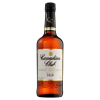
Canadian Whisky
Alcoholic (~40% ABV) Spirits
Canadian whisky is a style of whisky produced in Canada, typically made from a blend of grains with a high proportion of corn and smaller amounts of rye, barley, or wheat. Although often referred to as "rye whisky," most Canadian whiskies are corn-forward and designed for smoothness, lightness, and mixability rather than strong grain intensity.
Flavor & Technical
This section summarizes the sensory balance and technical behavior of Canadian Whisky when used in cocktails, combining perceived flavor intensity with functional roles.
Flavor balance and intensity
Technical characteristics
How Canadian Whisky works in cocktails
Canadian Whisky is analyzed here as a working cocktail ingredient: how it changes flavor, what role it plays in a build, when it should be substituted, and which recipe patterns it supports.
Flavor role in cocktail balance
Canadian whisky presents a soft, mellow profile driven by light corn sweetness and gentle oak influence. Common notes include vanilla , mild caramel, and subtle grain character, with restrained spice and minimal smokiness. Compared to bourbon or rye whiskey , Canadian whisky is generally lighter-bodied and cleaner, with a shorter finish and less assertive oak or grain intensity, emphasizing smoothness and easy drinkability.
Best uses behind the bar
Canadian whisky is widely used as a versatile base spirit in highballs and mixed drinks where a smooth, unobtrusive whisky backbone is desired. It performs well in simple stirred or shaken builds and in classic whisky cocktail families when a lighter, more approachable profile is preferred over bold grain or barrel character. It is also commonly enjoyed neat or over ice for casual sipping.
Substitutes in cocktail builds
Other blended whiskies provide the closest substitution with minimal impact on balance. Unpeated Irish whiskey is also an excellent substitute when similar lightness and clean mixability are desired. Light bourbon or blended Scotch may substitute structurally, but will introduce greater sweetness, oak, or malt character, increasing intensity compared to the typically softer and more neutral profile of Canadian whisky.
Production and style context
Canadian whisky production developed in the late 18th and 19th centuries as distilling traditions were brought to Canada by European settlers. The style gained international prominence during the Prohibition era in the United States, when Canadian distillers supplied a large market seeking smoother and more approachable whiskies.
Mixology notes
By law, Canadian whisky must be aged for a minimum of three years in wooden barrels. Despite the common nickname "rye whisky," most Canadian whiskies contain a majority of corn, with rye often used in smaller quantities to add aroma rather than dominant spice. Canadian regulations also allow producers to add a small portion of other spirits to refine the profile, commonly referenced as the "9.09% rule," which helps explain the category's renowned smoothness and versatility.